
Early Years Foundation Stage
Starting school is a very special milestone, and at High Legh Primary School we are committed to ensuring every child has a happy, confident and successful start to their learning journey.
We believe the Early Years lays the foundations for lifelong learning. Our Reception curriculum is carefully designed to nurture curious, confident and independent learners who develop a love of learning through high-quality teaching, purposeful play and meaningful experiences. We encourage children to become resilient, creative, inquisitive and kind, helping them develop the knowledge, skills and attitudes needed for future success.
Strong relationships are at the heart of everything we do. We work closely with families to ensure every child feels safe, valued and supported from the moment they join our school. By working together, we enable children to flourish both academically and personally.
Our Curriculum
Our curriculum is based on the Early Years Foundation Stage Framework and is informed by Development Matters. It provides a broad, balanced and ambitious education through the seven areas of learning:
- Personal, Social and Emotional Development
- Communication and Language
- Physical Development
- Literacy
- Mathematics
- Understanding the World
- Expressive Arts and Design
Learning is carefully planned to build children's knowledge and skills over time while remaining responsive to their interests and individual needs. Children learn through a balance of adult-led teaching, carefully planned play and opportunities to explore both indoors and outdoors.
A Two-Year Curriculum
As a small village school, our Key Stage 1 provision includes both a mixed Reception and Year 1 class and a mixed Year 1 and Year 2 class. Depending on cohort sizes and the needs of the children, pupils may move into either class as they progress through the school.
To ensure consistency and progression, we operate a carefully planned two-year rolling curriculum (Cycle A and Cycle B). This guarantees that every child experiences the full breadth of the Early Years Foundation Stage and Key Stage 1 curriculum without unnecessary repetition, regardless of which mixed-age class they are in.
Reception children always access the full Early Years Foundation Stage curriculum, with learning carefully matched to their developmental stage. Year 1 pupils build on this strong foundation through a smooth transition towards the National Curriculum, while teachers across both mixed-age classes work closely together to plan learning, share assessment information and ensure continuity, progression and high expectations for every child.
Learning Through Play
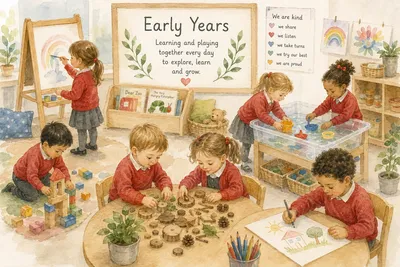
Play is central to learning in the Early Years. Through carefully planned provision, children investigate, explore, create, solve problems and develop their communication, language and social skills. Adults skilfully interact with children to extend their thinking, introduce new vocabulary and deepen learning through questioning, modelling and shared experiences.
Preparing for Year 1
Transition into Year 1 is carefully planned to ensure children continue to thrive. Throughout the year, Reception and Year 1 staff work closely together to plan learning, share assessment information and discuss each child's strengths and next steps.
Our mixed Reception and Year 1 provision enables children to become familiar with Key Stage 1 routines while continuing to benefit from an environment that values exploration, play and practical learning. This carefully planned approach supports children's confidence, independence and readiness for the next stage of their education.
Working in Partnership
We believe parents are children's first educators, and strong home-school partnerships are essential to children's success. We work closely with families throughout the year, sharing achievements, celebrating progress and providing opportunities for parents to support learning at home.
Together, we ensure every child leaves the Early Years as a confident, independent and enthusiastic learner, ready for the challenges and opportunities of Year 1.
Early Years Foundation Stage Policy
As a school, we believe that the early foundations of education are imperative to all that follows in the lives of children in today’s world. Our EYFS Curriculum provides a solid base for children to develop as lifelong readers, change makers, risk takers, creators and to be inquisitive, healthy and happy.
Intent
Our Aims
• We are healthy and happy
• We are lifelong readers
• We are change makers
• We are risk takers
• We are creators
• We are inquisitive (with a thirst for knowledge)
Implementation
Our curriculum is a plan of everything in the early years setting that we want our children to learn. At the heart of our curriculum is developing children’s vocabulary and language as this is vital to our children understanding and succeeding. Our curriculum is both ambitious and carefully sequenced to help our children to build their learning over time. Our curriculum and planning is flexible, as young children’s learning is often driven by their interests. We believe that depth in early learning is much more important than covering lots of things in a superficial way. We follow the ‘statutory framework for the early years foundation stage, 2021,’ and are guided by its four overarching principles:
• A unique child – we recognise that every child is unique, constantly learning and can be resilient, capable, confident and self-assured. They have their own interests, desires and personalities.
• Positive relationships – we recognise that children learn to be strong and independent through the interactions between themselves, families, practitioners and the wider community.
• Enabling environments with teaching and support from adults – we recognise that our environment plays a key part in helping children to learn and develop. We celebrate and respond to their individual interests and needs, building on learning continuously. We seek to provide strong partnerships with parents/carers.
• Learning and development – We understand that children develop at different rates. We ensure all children are supported equally to make progress and achieve their full potential. Children with particular needs, including SEND, are supported appropriately enabling them to succeed. Planning for learning takes into account the characteristics of effective learning (playing & exploring, active learning, creating & thinking critically)
Our EYFS curriculum is supported and enhanced through the use of Development Matters 2021, First 4 Maths and our Ready Steady Go phonics scheme. Our intention is for all children to achieve a good level of development by the end of EYFS by meeting the early learning goals. We are strongly committed to providing a play-based approach for children which will ensure high levels of engagement and autonomy alongside challenge and feedback.
Observation, Assessment and Planning
Over the course of the Reception year, we plan what it is we want our children to learn, to build their knowledge and their skills. We use our own expert professional judgement to make an accurate summative assessment at the end of the year. Teachers’ judgements will largely be based on whether children are learning what has
been taught and from their observations of development during day-to-day activity in the classroom. Our teacher will quickly identify children who need additional learning support, so that the appropriate additional teaching can be put in place. Our staff will actively engage children, their parents and other adults who have
significant interaction with the child in the assessment process. This will provide a rounded picture of the child’s development. We realise that a teacher’s relationship with parents is especially crucial when working with children from different cultural backgrounds, as parents can help practitioners understand the values that explain their child’s responses to the environment and social situations. The statutory EYFS framework requires the EYFS profile assessment to be carried out in the final term of the year in which a child reaches age 5, and no later than 30 June.
The EYFS profile is intended to provide a reliable, valid and accurate assessment of each child’s development at the end of the EYFS. It is made up of an assessment of the child’s outcomes in relation to the 17 early learning goal (ELG) descriptors. Practitioners use their professional judgement to make these assessments, based on their knowledge and understanding of what the child knows, understands, and can do. The EYFS profile is a statutory assessment of children’s development at the end of the early years foundation stage (known as a summative assessment). Day-to-day informal checking of what children have learnt will inform teaching and learning on an ongoing basis throughout the year in Reception. This will include identifying areas where children may be at risk of falling behind, so that our practitioners can provide rapid, effective support.
The main purpose of the profile assessment at the end of the EYFS is to support a successful transition to Key Stage 1 by informing the professional dialogue between EYFS and our Year 1 teacher. This informs our Year 1 teacher about each child’s stage of development and learning needs and help them to plan the Year 1 curriculum to meet the needs of all children. The EYFS profile is also used to inform parents about their child’s development.
Children are defined as having reached a Good Level of Development (GLD) at the end of the EYFS if they have achieved at least the expected level for the ELGs in the prime areas of learning and the specific areas of mathematics and literacy. This helps teachers and parents to understand broadly what a child can do in relation to national expectations. In addition, the EYFS profile provides a national child learning and development data set at the end of the EYFS.
We follow the guidance from the most up to date DFE Early Years Foundation Stage Profile Handbook.
Our Pedagogy
Our pedagogy is focussed around helping every child to learn. We know that every child can make progress in their learning through the right help, so we have a mixture of approaches. Children learn through; play, by adults modelling, by observing each other, and through guided learning and direct teaching. Our teacher ensures that carefully organised environments both inside and outside class are available for high-quality play.
Children are given time and space for children to invent their own play. Staff often join in to sensitively support and extend children’s learning. Our children also learn through focussed group work, when practitioners guide their learning. As children develop they receive more guided group learning.
Part of our pedagogy is supporting children to have self-regulation, the ability to; hold information in mind, focus their attention, think flexibly and inhibit impulsive behaviour.
We follow the 3 characteristics of effective teaching and learning taken from the Statutory Framework for EYFS and from Development Matters revised 2023. These are;
playing and exploring – children investigate and experience things, and ‘have a go’
active learning – children concentrate and keep on trying if they encounter difficulties, and enjoy achievements
creating and thinking critically – children have and develop their own ideas, make links between ideas, and develop strategies for doing things.
Our pedagogy is underpinned by the overarching principles of a unique child, positive relationships, enabling environments with teaching and support from adults and the importance of learning and development. Woven into this is a constant drive to celebrate, investigate and play with language.
Vocabulary is made explicit in all areas of the curriculum and staff model higher order language and conversations.
Our EYFS Curriculum covers seven areas of learning and development which are all carry equal importance within our holistic approach.
Prime areas
- Communication & Language
- Personal, Social and Emotional
- Physical Development
Specific Areas
- Literacy
- Mathematics
- Understanding the worlds
- Expressive arts and design
Play is at the heart of our curriculum. We believe it is the natural and instinctive way that children learn and we exploit this to develop an ethos of negotiated learning. Children should be fully absorbed in the classroom’s climate of learning; they will demonstrate a deep commitment to activities they undertake and make links between past and present learning. Challenges and depth of thinking should be pitched precisely by practitioners in order to guarantee learning is taking place. Constant practise and application of skills, concepts and knowledge will take place.
Our environment, inside and out, is created to be organised and stimulating to promote learning opportunities taking place. We provide a wide range of permanent areas of learning supporting the entire curriculum breadth. The planning process for these resources considers how areas and resources will naturally and automatically be used by children, allowing practitioners to observe children in their environment; assessing their interests, abilities and ‘characteristics of effective teaching and learning’ which in turn leads to quality interactions. Enhancements are thoughtfully provided in order to guide and
stimulate learning opportunities.
Mixed -Aged Class
At High Legh Primary School, our Reception children learn alongside a small number of Year 1 pupils within a mixed-age class. This carefully planned approach provides a nurturing and supportive environment that promotes a smooth transition from the Early Years Foundation Stage into Key Stage 1.
Learning is planned to meet the needs of both year groups, ensuring that Reception children continue to access the full Early Years Foundation Stage curriculum through a balance of child-initiated play and high-quality adult-directed teaching, while Year 1 pupils build upon their prior learning and gradually become familiar with the increased expectations of Key Stage 1.
The mixed-age environment offers many benefits. Reception children learn from positive Year 1 role models, developing confidence, independence and social skills, while Year 1 pupils consolidate their own knowledge by modelling language, routines and behaviours. Children work collaboratively, forming strong relationships across the age groups and developing empathy, communication and leadership skills.
Our approach also enables Year 1 pupils to continue accessing practical, play-based learning where appropriate, recognising that young children learn best through active exploration and meaningful experiences. This ensures that the transition into Key Stage 1 is gradual and responsive to children's developmental needs rather than defined by an abrupt change in teaching approaches.
By carefully blending the principles of the EYFS with the expectations of the National Curriculum, we provide continuity in learning, reduce anxiety associated with transition and ensure that every child develops the confidence, resilience and independence needed for future success.
Transitions
During the Summer Term prior to starting school the following September the following visits are conducted:
- Class teacher will visit pre-school settings from which September’s intake will be taken.
- Each child and their parents will be invited to spend some time at High Legh Primary School in order to familiarise themselves with both the staff and environment (usually 2 half days).
· Parent/carers will be invited to a ‘welcome’ event and we will share information relating to our school including curriculum, common questions, photo timetables. We also send home an ‘All About Me’ booklet for Parents/ carers to complete and return to school to find out more information about their unique child
Transition into Year 1 is carefully planned to ensure every child experiences a positive, seamless and successful move into the next stage of their education. At High Legh Primary School, children transition into either our mixed Reception/Year 1 class or our mixed Year 1/Year 2 class, depending on the organisation of the cohorts. This flexible approach allows us to meet the needs of all learners while providing continuity in both learning and pastoral care.
Throughout the year, the Reception and Year 1 teachers work closely together to plan learning, moderate assessments and discuss each child's academic progress, social development and individual needs. This collaborative approach ensures that teaching is matched to children's starting points and that any additional support or challenge is identified and implemented from the very beginning of the academic year. Particular attention is given to pupils with SEND or those requiring additional support to ensure appropriate provision continues seamlessly. By sharing expertise, maintaining consistent expectations and carefully planning the transition process, we ensure that every child is well supported, confident and ready to continue their learning journey.
Home and School Links
We recognise that parents and carers are a child’s first and most enduring educators and we aim for the school and parents /carers to work closely together. This can have a very positive impact on a child’s development which relies on a two-way flow of information and knowledge. Parents are invited into school to workshops throughout the year; Early Reading and Phonics, Mathematics and Writing and are encouraged to contribute each half term by completing ‘Wow moments’ and ‘Current Interest’ sheets for their child. We also hold regular ‘Learning Together’ sessions.
Inclusion and Equal Opportunities
Children with special educational needs will be supported as appropriate to enable them to access the curriculum fully. This includes children that are more able and those with specific learning difficulties and disabilities. School Focused Plans identify targets in specific areas of learning for those children who require additional support in line with the school’s Special Educational Needs Policy.
We will provide all children, regardless of ethnicity, culture, religion, home language, family background, learning difficulties, disabilities, gender or ability with equal access to all aspects of school life to ensure that every child is valued as an individual. All staff are role models and are aware of the influence they have in promoting positive attitudes and use that influence to challenge stereotypical attitudes.
Safe guarding and Welfare procedures
First and foremost, our role is to keep children safe. Safeguarding and welfare is a high priority in our school. Risk assessment and health and safety monitoring is a key part of school life ensuring children can be free to explore environments in a safe and stimulating manner. Health and wellbeing are embedded in our routines and practices. Further information can be found in the school Safeguarding and Child Protection Policies.
Monitoring
The policy will be monitored by the EYFS Lead Charlotte Bloor, the Headteacher and Governors.